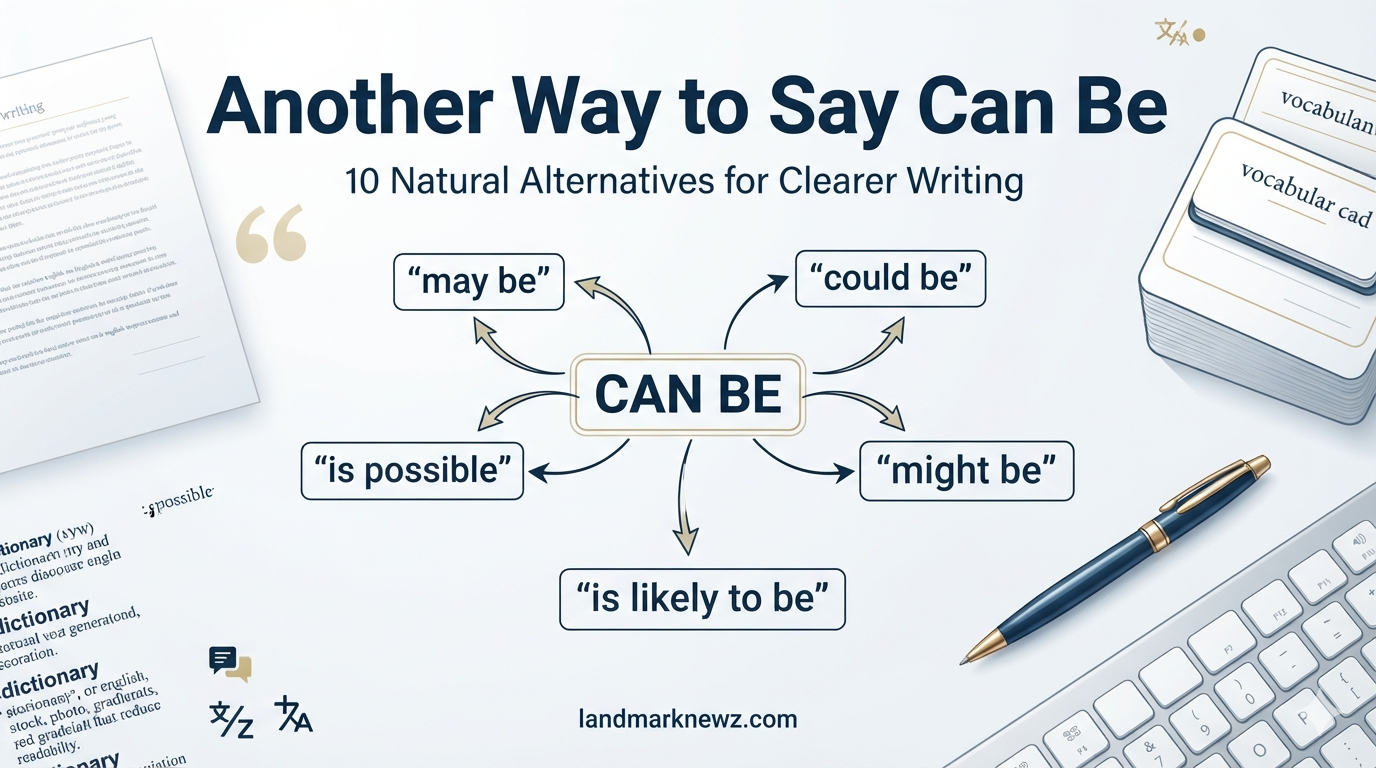
The phrase “can be” is common in everyday English, academic writing, professional communication, and conversation. However, repeating it too often can make your writing sound predictable or vague.
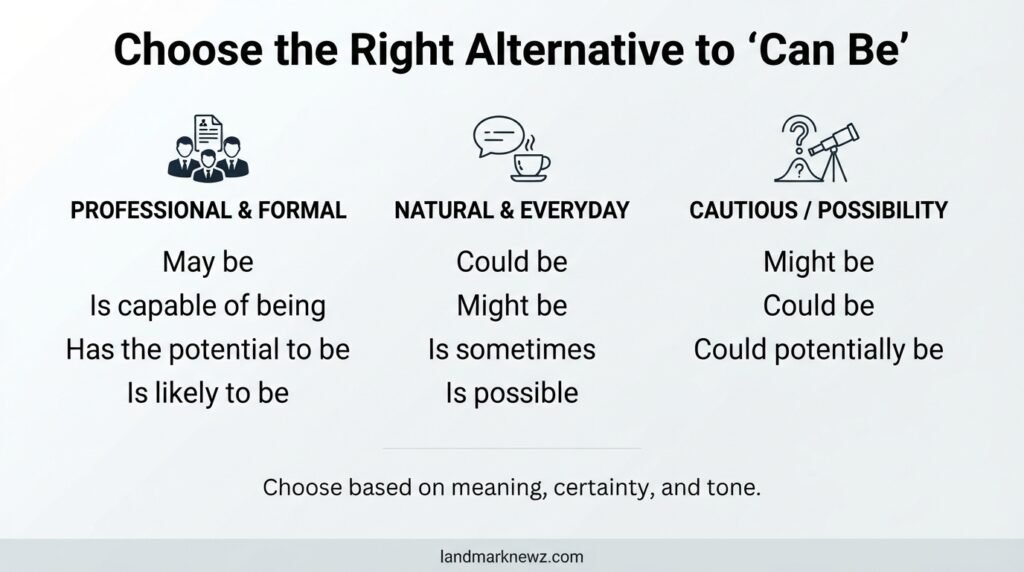
Fortunately, there are several natural alternatives. The right phrase depends on what “can be” means in your sentence—possibility, ability, probability, or a general condition.
What Does “Another Way to Say Can Be” Mean?
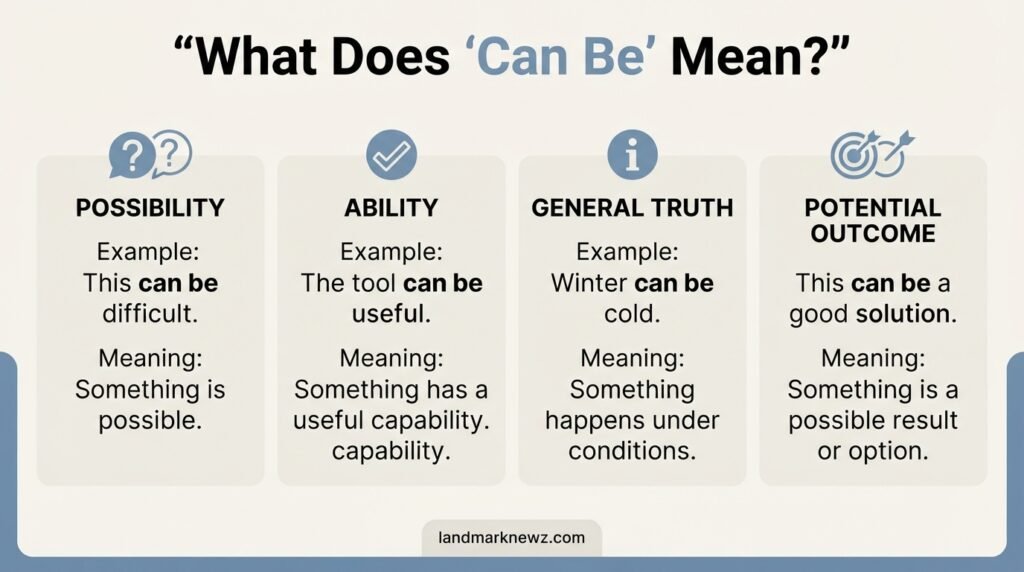
“Another way to say can be” means finding a different expression that communicates the same or a similar idea without using “can be.”
For example, instead of saying, “This can be difficult,” you could say, “This may be challenging,” “This could be difficult,” or “This is sometimes challenging.”
The best replacement depends on your intended meaning. Some alternatives show possibility, while others emphasize ability, uncertainty, or likelihood.
Why Use Other Ways to Say “Can Be”?
Using alternatives to “can be” can make your writing more precise and varied. It also helps you communicate the exact level of possibility or certainty you intend.
Consider using another expression to:
- Avoid repeating the same phrase.
- Make professional writing more polished.
- Show different levels of certainty.
- Improve academic or business writing.
- Make sentences sound more natural.
- Express possibility or potential more precisely.
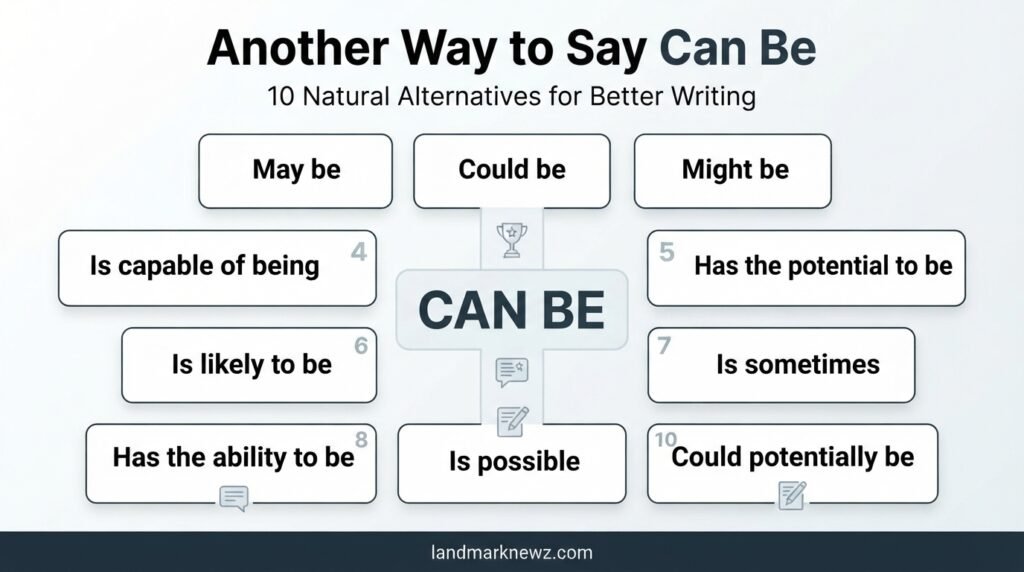
10 Best Other Ways to Say “Can Be”
1. May Be
Meaning
“May be” is one of the closest alternatives to “can be” when you want to express possibility. It suggests that something is possible without saying that it definitely will happen.
Best For
- Professional
- Formal
- Polite
Example 1
The new schedule may be more convenient for the entire team.
Example 2
This approach may be useful for reducing unnecessary costs.
Quick Tip
Use “may be” when you want to sound measured and professional while discussing a possible situation.
2. Could Be
Meaning
“Could be” expresses a possible situation, result, or explanation. It often sounds natural in both conversation and professional writing.
Best For
- Professional
- Casual
- Friendly
- Polite
Example 1
The delay could be related to the recent system update.
Example 2
A short break could be exactly what you need before continuing the project.
Quick Tip
Choose “could be” when you want to present an option or possibility without making a firm claim.
3. Might Be
Meaning
“Might be” indicates possibility but usually sounds slightly less certain than “may be.” It is useful when you do not have enough information to make a stronger statement.
Best For
- Professional
- Casual
- Friendly
Example 1
The missing information might be available in the original report.
Example 2
Friday afternoon might be a better time for the meeting.
Quick Tip
Use “might be” when you want to communicate uncertainty clearly and naturally.
4. Is Capable of Being
Meaning
“Is capable of being” emphasizes ability or potential rather than simple possibility. It works particularly well when describing what a person, system, process, or object is able to become or achieve.
Best For
- Professional
- Formal
Example 1
The software is capable of being customized for different business needs.
Example 2
The material is capable of being recycled after use.
Quick Tip
Use this phrase when “can be” refers to an actual capability rather than an uncertain possibility.
5. Has the Potential to Be
Meaning
“Has the potential to be” suggests that something could develop into a particular state or produce a particular result. It is especially useful when discussing future possibilities.
Best For
- Professional
- Formal
Example 1
The proposal has the potential to be a valuable addition to the company’s strategy.
Example 2
This early research has the potential to be highly influential in the field.
Quick Tip
This alternative is ideal when discussing opportunities, growth, improvement, or future outcomes.
6. Is Likely to Be
Meaning
“Is likely to be” communicates a strong possibility or expectation. Unlike “can be,” it suggests that something has a relatively high chance of occurring or being true.
Best For
- Professional
- Formal
- Polite
Example 1
The final decision is likely to be announced next week.
Example 2
The updated process is likely to be easier for new employees to follow.
Quick Tip
Use this expression when you want to communicate probability rather than general possibility.
7. Is Sometimes
Meaning
“Is sometimes” works when “can be” describes something that happens or exists under certain circumstances. It is particularly useful for general observations.
Best For
- Professional
- Casual
- Friendly
Example 1
Working remotely is sometimes challenging for new team members.
Example 2
A simple solution is sometimes the most effective option.
Quick Tip
Use “is sometimes” when the original sentence describes something that occurs occasionally.
8. Has the Ability to Be
Meaning
“Has the ability to be” emphasizes a person or thing’s capacity to reach a particular state or perform a function. It is more explicit than the shorter “can be.”
Best For
- Professional
- Formal
Example 1
The platform has the ability to be integrated with existing business tools.
Example 2
The training program has the ability to be adapted for different experience levels.
Quick Tip
This phrase works best when you are emphasizing capability, especially in business, technical, or instructional writing.
9. Is Possible
Meaning
“Is possible” directly communicates that something can happen or exist. It often creates a concise and clear alternative when the sentence structure allows you to rewrite the original wording.
Best For
- Professional
- Formal
- Polite
Example 1
A complete refund is possible under the terms of the agreement.
Example 2
Further improvement is possible with additional training and practice.
Quick Tip
Use “is possible” when you want a straightforward statement without emphasizing who or what has the ability to cause the outcome.
10. Could Potentially Be
Meaning
“Could potentially be” emphasizes that an outcome is possible but not certain. It is useful when discussing ideas, risks, opportunities, or future results.
Best For
- Professional
- Formal
- Polite
Example 1
The new strategy could potentially be more effective than the current approach.
Example 2
That small change could potentially be enough to improve customer satisfaction.
Quick Tip
Use this phrase when you want to highlight a possible future outcome, but avoid it when a simpler “could be” communicates the idea clearly.
Comparison Table
| Alternative | Best Used In | Tone |
| May be | Professional emails, formal writing | Professional, measured |
| Could be | Everyday and professional communication | Natural, flexible |
| Might be | Uncertain situations | Cautious |
| Is capable of being | Technical and professional writing | Formal |
| Has the potential to be | Business, academic, future-focused writing | Professional |
| Is likely to be | Predictions and expectations | Confident |
| Is sometimes | General observations | Natural |
| Has the ability to be | Capability-focused writing | Formal |
| Is possible | Clear, direct statements | Neutral |
| Could potentially be | Future possibilities | Cautious, professional |
Common Mistakes
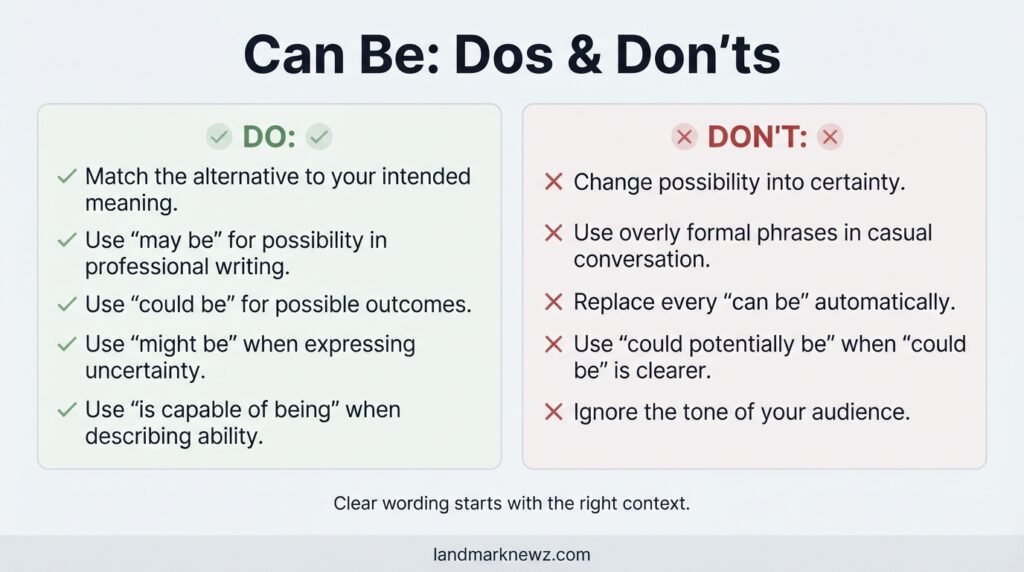
1. Treating Every Alternative as Interchangeable
Not every replacement has exactly the same meaning. For example, “is likely to be” suggests a stronger probability than “might be.”
2. Using Overly Formal Language
Phrases such as “has the ability to be” can sound unnecessarily wordy in casual conversation. A simple “can be” or “could be” may work better.
3. Changing the Intended Meaning
Replacing “can be” with “will be” can make a sentence much more certain. Always check whether your new wording changes the original meaning.
4. Ignoring Sentence Structure
Some alternatives require a sentence to be rewritten. For example, “can be completed” may become “is possible to complete” rather than simply replacing one phrase word for word.
5. Overusing “Could Potentially Be”
Although grammatically acceptable, “could potentially be” can sometimes sound repetitive because both words already communicate possibility. In many cases, “could be” is cleaner.
Frequently Asked Questions
What is the best alternative to “can be”?
“May be” is often the best alternative when you want to express possibility in professional or formal writing. However, “could be” is usually more natural in everyday communication. The best choice depends on whether you are describing possibility, ability, probability, or a general condition.
Is “may be” the same as “can be”?
Not always. “May be” generally expresses possibility, while “can be” can express possibility, ability, or a general fact. For example, “This may be difficult” means difficulty is possible, while “This can be difficult” can describe something that is generally capable of being difficult.
What is a professional way to say “can be”?
Professional alternatives include “may be,” “could be,” “is capable of being,” “has the potential to be,” and “is likely to be.” Your choice should depend on the intended meaning. For straightforward professional writing, “may be” and “could be” are often the most natural options.
What is another way to say “can be used”?
Depending on the context, you could say “may be used,” “could be used,” “is suitable for,” “is designed for,” or “is capable of being used.” The best option depends on whether you are describing permission, possibility, suitability, or technical capability.
What is another way to say “can be difficult”?
Natural alternatives include “may be difficult,” “could be challenging,” “might be challenging,” and “is sometimes difficult.” Use “may be difficult” for a professional tone and “could be challenging” when you want a slightly softer, more conversational expression.
Can “could be” replace “can be”?
Often, yes, but the meaning can shift slightly. “Could be” usually presents something as a possibility, while “can be” may describe a general possibility or ability. Before replacing the phrase, consider whether you are making a general statement or discussing a particular possible outcome.
What is a formal way to say “can be”?
For formal writing, options include “may be,” “is capable of being,” “has the potential to be,” and “is likely to be.” However, formal does not always mean better. Choose the simplest phrase that accurately expresses your intended meaning.
How do I choose the right alternative to “can be”?
First, identify what “can be” means in your sentence. Use “may be” or “might be” for possibility, “could be” for possible outcomes, “is likely to be” for probability, and “is capable of being” for ability. This approach keeps your writing accurate and natural.
Conclusion
Finding another way to say “can be” is useful when you want clearer, more varied, or more precise writing. However, the best alternative depends on the meaning you want to communicate.
For general possibility, “may be” and “could be” are excellent choices. If you want to show uncertainty, “might be” works well. For ability, consider “is capable of being” or “has the ability to be.” When discussing future opportunities, “has the potential to be” is a strong option, while “is likely to be” works better for probable outcomes.
The key is not simply to replace “can be” with a more complicated phrase. Choose the alternative that matches your meaning, audience, and tone. Clear writing is usually the strongest writing. For more guidance, see Purdue OWL’s advice on choosing the right words for clarity, tone, and audience.

About Dr. Priya Nair
Dr. Priya Nair is a passionate Writer & Blogger at LandMarkNewz.com, dedicated to creating informative, engaging, and easy-to-understand content for readers. With a strong interest in research, current trends, lifestyle, and everyday topics, she focuses on presenting useful information in a clear and reader-friendly way.
Through her writing, Priya aims to help readers discover valuable insights, understand complex topics more easily, and stay informed about subjects that matter to them. Her approach combines thoughtful research with a simple and engaging writing style.
At LandMarkNewz.com, she contributes original articles designed to inform, educate, and provide practical value to readers.