What Does “Another Way to Say Lessons Learned” Mean?
The phrase “another way to say lessons learned” refers to different expressions that describe the knowledge, insights, or understanding gained from an experience. People often look for alternatives to avoid repetition or make their writing sound more polished.
“Lessons learned” commonly appears in project reports, performance reviews, presentations, resumes, academic work, business discussions, and personal reflections. Depending on the situation, you might use “key takeaways,” “insights gained,” or “valuable learnings” instead.
Why Use Other Ways to Say “Lessons Learned”?
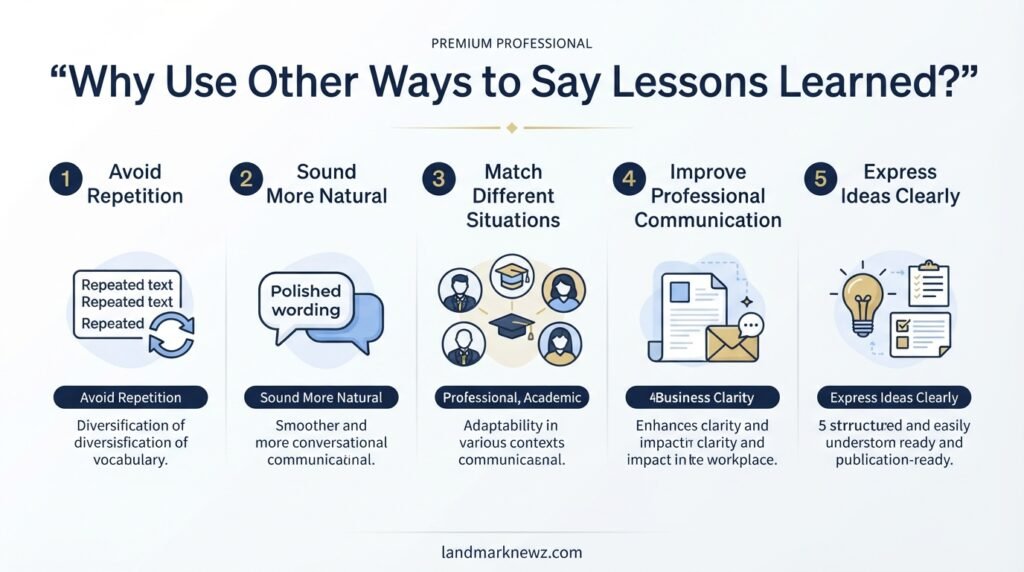
Using different expressions can make your writing more precise and natural. While “lessons learned” is widely understood, another phrase may better match your audience or the specific experience you are describing.
You may want an alternative to:
- Avoid repeating the same phrase.
- Make professional writing sound more polished.
- Highlight specific knowledge gained from an experience.
- Match a formal, casual, or reflective tone.
- Describe growth without focusing on mistakes.
10 Best Other Ways to Say “Lessons Learned”
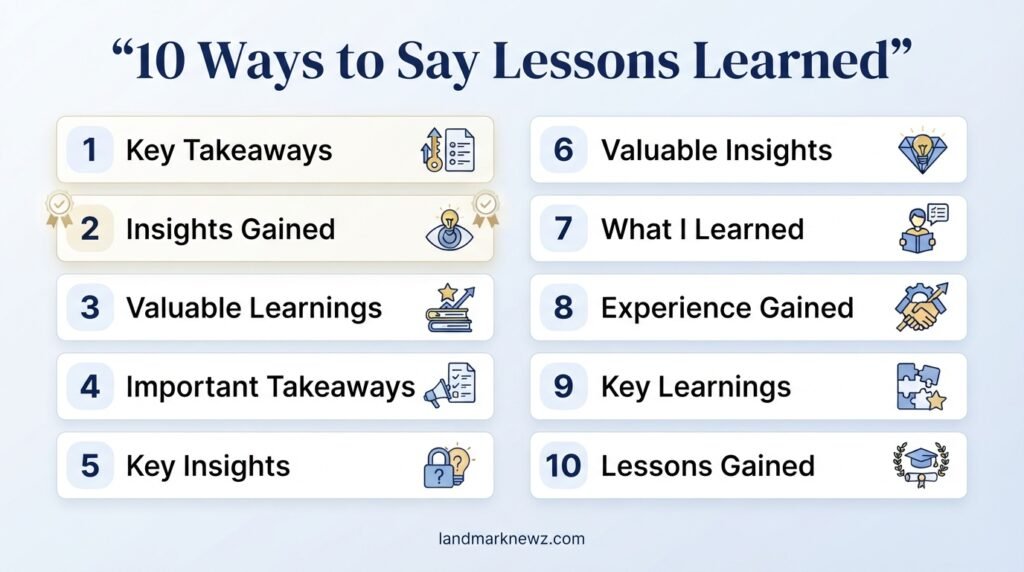
1. Key Takeaways
Meaning
“Key takeaways” refers to the most important ideas, insights, or points someone gains from an experience. It is especially useful when summarizing a project, meeting, presentation, training session, or report.
Best For
- Professional
- Formal
- Polite
Example 1
The key takeaways from the project will help our team improve future planning.
Example 2
Here are the key takeaways from this quarter’s customer feedback.
Quick Tip
Use “key takeaways” when you want to emphasize the most useful points rather than every detail learned.
2. Insights Gained
Meaning
“Insights gained” highlights a deeper understanding developed through experience, research, observation, or reflection. It sounds polished without being overly formal.
Best For
- Professional
- Formal
- Academic
Example 1
The insights gained from the study will guide our next phase of research.
Example 2
She discussed the insights gained while managing the new team.
Quick Tip
Choose this phrase when the experience led to a meaningful understanding rather than simply new information.
3. Valuable Learnings
Meaning
“Valuable learnings” describes useful knowledge or understanding gained through an experience. It is common in workplace discussions, project reviews, and business presentations.
Best For
- Professional
- Formal
Example 1
The project provided several valuable learnings about customer communication.
Example 2
We documented the valuable learnings before starting the next campaign.
Quick Tip
Use this option when you want to emphasize that the experience produced practical value.
4. Important Takeaways
Meaning
“Important takeaways” focuses on the main points that deserve attention after an experience or discussion. It works well when you want to signal that certain conclusions matter more than others.
Best For
- Professional
- Formal
- Polite
Example 1
The meeting produced several important takeaways for the marketing team.
Example 2
My important takeaways from the workshop included better ways to manage deadlines.
Quick Tip
This phrase works particularly well before a short summary or bullet list.
5. Key Insights
Meaning
“Key insights” refers to the most meaningful discoveries or observations gained from an experience. It is a strong choice for reports, presentations, research, and business communication.
Best For
- Professional
- Formal
- Academic
Example 1
The key insights from our customer survey changed how we approached the product launch.
Example 2
The report outlines key insights from six months of testing.
Quick Tip
Use “key insights” when your experience revealed something that can influence future decisions.
6. Valuable Insights
Meaning
“Valuable insights” emphasizes the usefulness of what you discovered or understood. It sounds professional while still feeling natural and straightforward.
Best For
- Professional
- Formal
- Polite
Example 1
The internship gave me valuable insights into the daily responsibilities of a project manager.
Example 2
Our discussion offered valuable insights into what customers expect from the service.
Quick Tip
This phrase is useful when describing how an experience improved your understanding of a subject.
7. What I Learned
Meaning
“What I learned” is a direct and conversational way to introduce knowledge gained from an experience. It works particularly well in personal reflections, interviews, presentations, and informal writing.
Best For
- Casual
- Friendly
- Professional
Example 1
One thing I learned was the importance of communicating project changes early.
Example 2
What I learned from the experience will influence how I approach similar challenges.
Quick Tip
Use this option when you want your writing to sound personal and easy to understand.
8. Experience Gained
Meaning
“Experience gained” focuses on practical knowledge and skills developed through participation or hands-on work. It is especially useful when discussing careers, internships, projects, and professional development.
Best For
- Professional
- Formal
Example 1
The experience gained during the internship strengthened my problem-solving skills.
Example 2
The experience gained from managing the project prepared me for larger responsibilities.
Quick Tip
Use this phrase when the benefit involves practical skills or real-world exposure.
9. Key Learnings
Meaning
“Key learnings” identifies the most important knowledge or conclusions gained from an activity or experience. It is common in business, training, marketing, and project discussions.
Best For
- Professional
- Formal
Example 1
The presentation concluded with five key learnings from the campaign.
Example 2
We reviewed the key learnings before developing the new strategy.
Quick Tip
“Key learnings” works well in workplace documents, especially when followed by a numbered or bulleted list.
10. Lessons Gained
Meaning
“Lessons gained” communicates the useful understanding or knowledge that came from an experience. It stays close to the original phrase while providing a slight variation.
Best For
- Professional
- Formal
- Reflective
Example 1
The lessons gained from the setback helped the team create a stronger process.
Example 2
He reflected on the lessons gained during his first year as a supervisor.
Quick Tip
Choose this phrase when you want to preserve the meaning of “lessons learned” while changing the wording.
Comparison Table
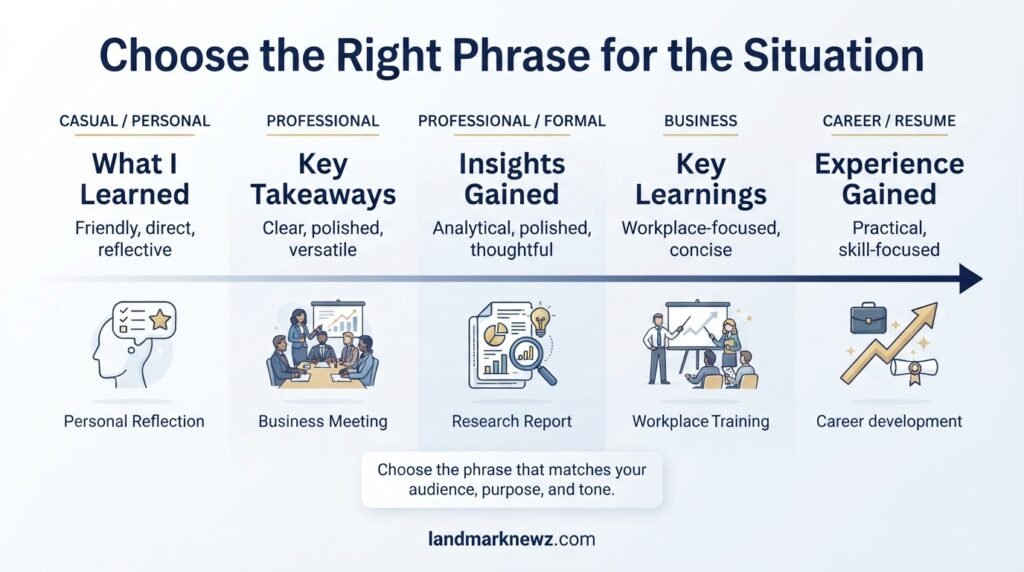
| Alternative | Best Used In | Tone |
| Key Takeaways | Reports, meetings, presentations | Professional |
| Insights Gained | Research, reports, reflections | Formal |
| Valuable Learnings | Business, project reviews | Professional |
| Important Takeaways | Summaries, presentations | Polite |
| Key Insights | Research, business reports | Formal |
| Valuable Insights | Professional discussions | Professional |
| What I Learned | Reflections, interviews | Friendly |
| Experience Gained | Resumes, career discussions | Professional |
| Key Learnings | Business, training, projects | Formal |
| Lessons Gained | Reflections, reports | Reflective |
Common Mistakes
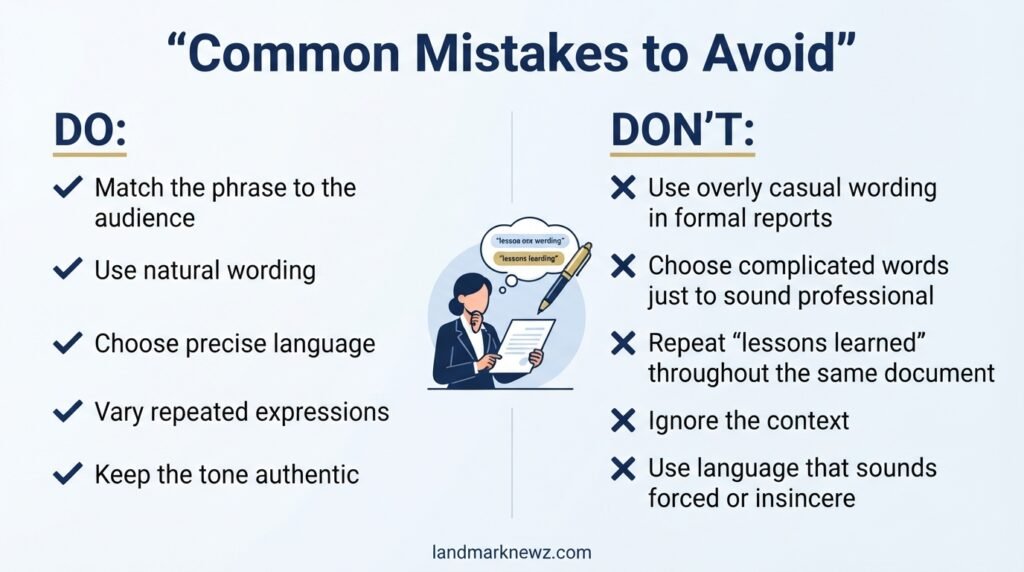
1. Using a casual phrase in a formal document
Phrases such as “what I learned” can sound too conversational in some corporate reports. Choose “insights gained” or “key takeaways” when a more polished tone is appropriate.
2. Choosing overly formal language
Not every situation requires sophisticated wording. In a personal reflection, “what I learned” may sound much more natural than “valuable insights acquired.”
3. Repeating the same phrase
Using “lessons learned” several times in one report can make the writing feel repetitive. Alternate between closely related expressions when the context allows.
4. Forgetting the context
Some alternatives focus on knowledge, while others emphasize skills or practical experience. For example, “experience gained” is better for hands-on development than for summarizing ideas from a meeting.
5. Sounding insincere
Avoid choosing complicated wording simply to sound professional. The best alternative is the one that accurately describes what you actually learned or experienced.
Frequently Asked Questions
What is the best professional way to say “lessons learned”?
“Key takeaways” and “insights gained” are two strong professional alternatives. “Key takeaways” works well for reports, meetings, and presentations, while “insights gained” is better when you want to emphasize deeper understanding. For practical workplace experience, “experience gained” may be more precise.
What is another way to say “lessons learned” in a report?
For a report, consider “key takeaways,” “key insights,” “insights gained,” or “valuable learnings.” These phrases work well because they clearly introduce conclusions or useful information without sounding overly casual. Choose the option that best matches whether your report focuses on findings, experience, or recommendations.
What is a simple way to say “lessons learned”?
“What I learned” is one of the simplest alternatives. It sounds natural, direct, and personal. You can also use “what we learned” when writing on behalf of a team. These expressions are particularly useful in reflections, presentations, interviews, and informal workplace communication.
What is another way to say “lessons learned” in business?
Business professionals often use “key takeaways,” “key learnings,” “valuable insights,” or “insights gained.” These alternatives work well in project reviews, strategy meetings, training materials, and presentations. “Key takeaways” is usually the safest general-purpose choice because it is clear and widely understood.
Can I use “key learnings” instead of “lessons learned”?
Yes. “Key learnings” is a common alternative, particularly in business and marketing contexts. It emphasizes the most important knowledge gained from a project or activity. However, if you are writing for a very formal audience, “key insights” or “findings” may sound more precise depending on the subject.
What is a good resume alternative to “lessons learned”?
“Experience gained” is often a better resume choice because resumes typically emphasize skills, accomplishments, and practical experience. Instead of simply stating lessons learned, describe what you gained or improved, such as project management experience, communication skills, or problem-solving ability.
Is “valuable learnings” grammatically correct?
Yes, “valuable learnings” is widely used, especially in professional and business communication. However, “learnings” can sound like corporate jargon in some contexts. If you want simpler wording, “valuable insights,” “key takeaways,” or “what I learned” may sound more natural.
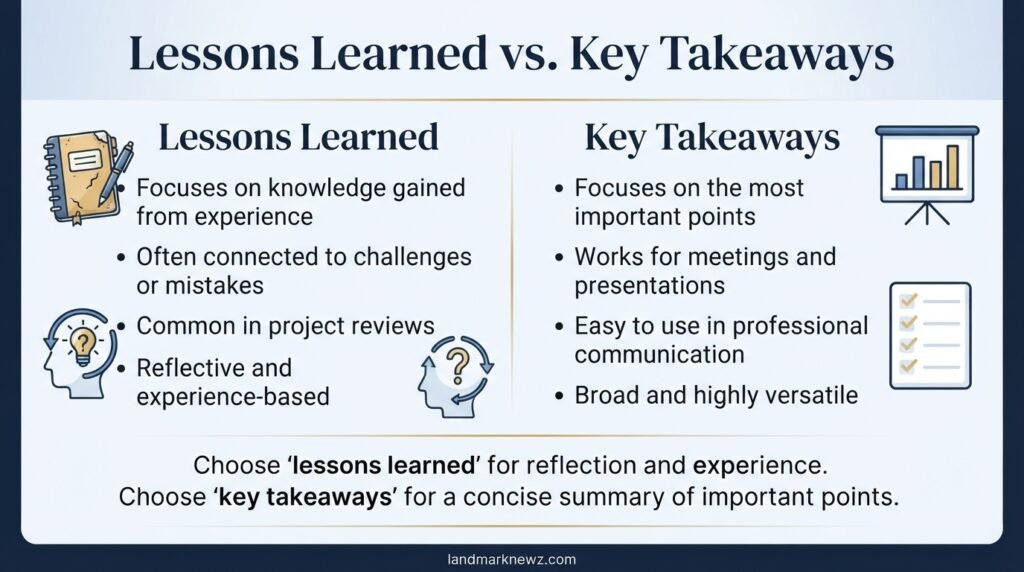
What is the difference between “lessons learned” and “key takeaways”?
“Lessons learned” often suggests knowledge gained from an experience, including mistakes or challenges. “Key takeaways” is broader and simply identifies the most important points or ideas. As a result, “key takeaways” can work for meetings, articles, presentations, and events where no mistake or problem was involved.
Conclusion
There are many natural alternatives to “lessons learned,” but the best choice depends on your purpose. “Key takeaways” is a versatile option for reports, meetings, and presentations, while “insights gained” works well when you want to highlight deeper understanding.
For workplace discussions, “key learnings” and “valuable insights” can sound polished and professional. If you are writing a personal reflection, “what I learned” feels more direct and authentic. Meanwhile, “experience gained” is especially useful when describing professional development or practical skills.
The key is to choose language that accurately reflects the experience. Instead of changing the phrase simply for variety, select an alternative that makes your meaning clearer and fits your audience naturally. For more guidance, see Purdue OWL’s advice on choosing words that fit your audience.

Language & Everyday Communication Specialist
Elena Voss is a language enthusiast and communication coach with over 9 years of experience helping people express themselves more naturally in English. She previously worked as an ESL instructor and corporate language trainer, guiding professionals and students on clearer everyday conversations, polite alternatives, and natural phrasing.
Elena specializes in practical synonym guides and “another way to say…” content that feels conversational rather than textbook. Her writing focuses on real-life situations — emails to friends, casual workplace chat, social media, and daily interactions. She believes the best language advice is simple, useful, and easy to remember.
When she’s not creating content for LandmarkNewz, Elena enjoys analyzing modern slang trends and testing new phrases in real conversations.