
What Does “Another Way to Say Research Shows” Mean?
The phrase “another way to say research shows” refers to alternative expressions for presenting information supported by studies, evidence, data, or scientific findings.
People often look for alternatives because repeating “research shows” can make an article, report, essay, or presentation sound monotonous. Different phrases can also communicate whether the evidence is strong, preliminary, widely accepted, or still developing.
You may see these expressions in academic papers, business reports, news articles, medical writing, presentations, and educational content.
Why Use Other Ways to Say “Research Shows”?
Choosing a different expression can make your writing clearer and more precise. It also helps you match the wording to the strength of the evidence.
- Avoid repetition: Keep research-based writing from sounding repetitive.
- Sound natural: Use language that fits the surrounding sentence.
- Match the context: Academic, business, journalistic, and casual writing may need different wording.
- Improve precision: Some phrases sound stronger or more cautious than others.
- Strengthen credibility: Accurate wording shows that you understand what the evidence actually supports.
10 Best Other Ways to Say “Research Shows”
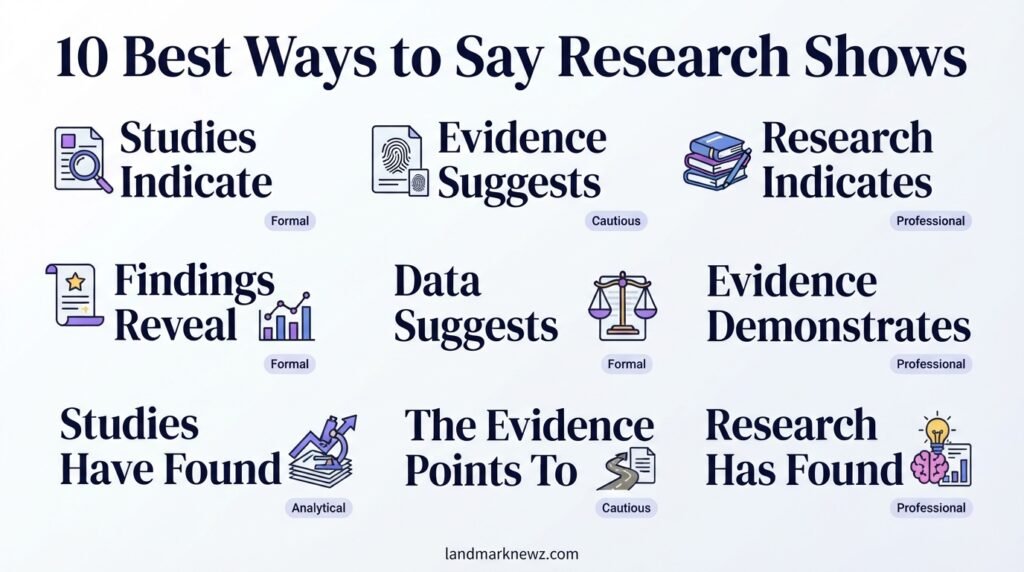
1. Studies Indicate
Meaning
“Studies indicate” is a natural and professional alternative when one or more studies point toward a particular conclusion. It works especially well when the findings provide meaningful evidence but may not prove the claim beyond doubt.
Best For
- Professional
- Formal
Example 1
Studies indicate that regular physical activity can support better sleep quality.
Example 2
Recent studies indicate that customers value faster response times from online businesses.
Quick Tip
Use “studies indicate” when you are referring to findings from specific studies rather than research in a broad sense.
2. Evidence Suggests
Meaning
“Evidence suggests” presents a conclusion in a careful and measured way. It is useful when available evidence supports an idea but does not necessarily establish it as an absolute fact.
Best For
- Professional
- Formal
Example 1
Evidence suggests that early planning can reduce project delays.
Example 2
Current evidence suggests that children learn new vocabulary more effectively through repeated exposure.
Quick Tip
Choose this phrase when you want your writing to sound credible without overstating the findings.
3. Research Indicates
Meaning
“Research indicates” stays very close in meaning to “research shows,” but it often sounds slightly more formal. It works well in reports, academic writing, professional articles, and evidence-based explanations.
Best For
- Professional
- Formal
Example 1
Research indicates that clear instructions can improve employee performance.
Example 2
Recent research indicates that consumers prefer websites that are easy to navigate.
Quick Tip
This is one of the safest replacements when you want a direct, professional substitute.
4. Findings Reveal
Meaning
“Findings reveal” focuses attention on the results discovered through a study or investigation. It is particularly useful when the results provide a notable insight or uncover something that was not immediately obvious.
Best For
- Professional
- Formal
Example 1
The study’s findings reveal a strong connection between exercise and workplace productivity.
Example 2
Survey findings reveal that many customers prefer receiving updates by email.
Quick Tip
Use “findings reveal” when you have already mentioned a study, survey, experiment, or investigation.
5. Data Suggests
Meaning
“Data suggests” is useful when numerical information or collected measurements support a particular interpretation. It emphasizes the information itself rather than the researchers who gathered it.
Best For
- Professional
- Formal
Example 1
The data suggests that demand for electric vehicles is increasing.
Example 2
Customer data suggests that shorter checkout processes lead to fewer abandoned purchases.
Quick Tip
Use this phrase when your claim is directly connected to statistics, measurements, survey results, or other collected data.
6. Evidence Demonstrates
Meaning
“Evidence demonstrates” is stronger than “evidence suggests.” It implies that the available evidence provides clear support for the statement you are making.
Best For
- Professional
- Formal
Example 1
The available evidence demonstrates the value of regular employee training.
Example 2
Clinical evidence demonstrates that consistent treatment can improve patient outcomes.
Quick Tip
Do not use this phrase for weak or preliminary evidence because it can make your claim sound stronger than the research supports.
7. Studies Have Found
Meaning
“Studies have found” is a straightforward way to introduce established findings. It sounds natural and works well when several studies have produced relevant results.
Best For
- Professional
- Formal
- Friendly
Example 1
Studies have found that people tend to remember information better when it is presented visually.
Example 2
Several studies have found that workplace flexibility can influence employee satisfaction.
Quick Tip
This phrase is especially useful when you want your writing to sound clear and accessible rather than highly academic.
8. Research Supports
Meaning
“Research supports” means that existing research provides evidence in favor of a particular idea, claim, or practice. It is useful when you want to connect evidence directly to a recommendation or conclusion.
Best For
- Professional
- Formal
Example 1
Research supports the use of regular feedback to improve learning outcomes.
Example 2
Existing research supports the idea that strong customer service can increase brand loyalty.
Quick Tip
Use “research supports” when the evidence backs a specific position rather than simply reporting a finding.
9. The Evidence Points To
Meaning
“The evidence points to” presents a conclusion while leaving room for uncertainty. It suggests that several pieces of information collectively lead toward a particular explanation or result.
Best For
- Professional
- Formal
- Friendly
Example 1
The evidence points to improved communication as a key factor in the team’s success.
Example 2
Taken together, the evidence points to a need for better public transportation options.
Quick Tip
This phrase works well when several sources of evidence contribute to the same conclusion.
10. Research Has Found
Meaning
“Research has found” is a simple and versatile expression for reporting research-based discoveries. It sounds natural in articles, educational content, reports, and general informational writing.
Best For
- Professional
- Formal
- Friendly
Example 1
Research has found that regular breaks can help people maintain concentration.
Example 2
Recent research has found a relationship between sleep habits and daytime alertness.
Quick Tip
Use this option when you want an easy-to-understand alternative without making your sentence sound overly formal.
Comparison Table
| Alternative | Best Used In | Tone |
| Studies indicate | Academic writing, reports | Formal |
| Evidence suggests | Research, analysis | Cautious |
| Research indicates | Professional writing | Formal |
| Findings reveal | Reports, studies | Informative |
| Data suggests | Business, analytics | Analytical |
| Evidence demonstrates | Academic, scientific writing | Strong |
| Studies have found | Articles, reports | Clear |
| Research supports | Recommendations, essays | Authoritative |
| The evidence points to | Analysis, discussion | Measured |
| Research has found | General informational writing | Neutral |
Common Mistakes
1. Using Strong Language for Weak Evidence
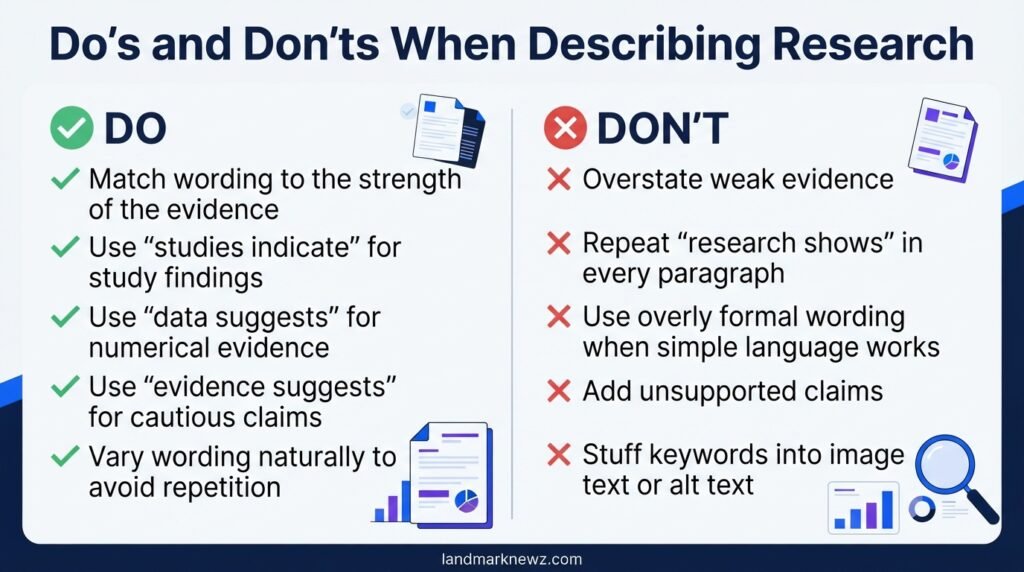
Avoid saying “evidence demonstrates” when a study only suggests a possible relationship. Your wording should reflect the actual strength of the findings.
2. Repeating “Research Shows” Too Often
Using the same phrase throughout an article can make the writing feel mechanical. Alternate between accurate expressions such as “studies indicate” and “evidence suggests.”
3. Ignoring the Source of the Evidence
“Data suggests” is most appropriate when data directly supports the statement. If you are discussing published studies, “research indicates” may be more precise.
4. Making a Claim Sound Certain
Research does not always prove a cause-and-effect relationship. When findings are limited or preliminary, cautious wording such as “evidence suggests” is often better.
5. Choosing a Phrase Only Because It Sounds Formal
More formal does not always mean better. The goal is to describe the evidence accurately while keeping the sentence natural and easy to understand.
Frequently Asked Questions
What is a professional way to say “research shows”?
A professional alternative is “research indicates.” You can also use “studies indicate,” “evidence suggests,” or “research supports,” depending on the context. “Research indicates” is especially useful in business reports, academic writing, presentations, and professional articles because it sounds polished without being unnecessarily complicated.
What is another way to say “research shows that”?
You can replace “research shows that” with “research indicates that,” “studies suggest that,” “evidence suggests that,” or “research has found that.” The best option depends on how strong the evidence is and whether you are referring to a specific study, multiple studies, or research in general.
Is “research indicates” the same as “research shows”?
The two phrases have very similar meanings, but “research indicates” can sound slightly more cautious. “Research shows” may present a finding more directly, while “research indicates” often suggests that the evidence points toward a conclusion without necessarily claiming absolute proof.
What is a formal way to say “research shows”?
For formal writing, consider “studies indicate,” “research indicates,” “evidence demonstrates,” or “the findings indicate.” However, “evidence demonstrates” should only be used when the evidence strongly supports the claim. In academic writing, accuracy is more important than choosing the most formal-sounding expression.
Can I use “studies suggest” instead of “research shows”?
Yes. “Studies suggest” is a useful alternative when the findings point toward a conclusion but do not establish it with certainty. It is particularly helpful when discussing observational research, early findings, or topics where scientists continue to investigate different explanations.
What is a cautious alternative to “research shows”?
“Evidence suggests” is one of the best cautious alternatives. It indicates that the available evidence supports an idea while avoiding an overly strong claim. This wording works well when research is limited, findings are mixed, or more investigation is needed before reaching a firm conclusion.
What is another way to say “research has shown”?
You can say “research has found,” “studies have found,” “research indicates,” or “previous studies have demonstrated.” “Research has found” is a particularly natural choice for general articles, while “previous studies have demonstrated” sounds more formal and academic.
How do I choose the best alternative to “research shows”?
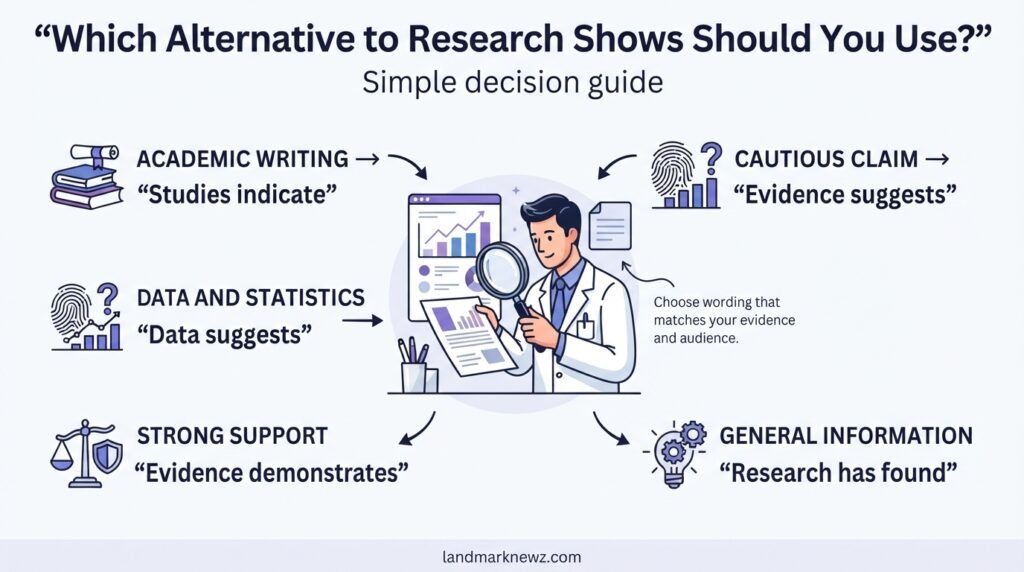
Start by considering the evidence. Use “studies indicate” for research findings, “evidence suggests” for cautious claims, “data suggests” for numerical information, and “evidence demonstrates” for well-supported conclusions. The strongest option is not always the best one; choose the phrase that accurately reflects what the evidence can support.
Conclusion
There are many effective alternatives to “research shows,” but the right choice depends on your evidence and audience. For professional and academic writing, “research indicates” and “studies indicate” are reliable options. If you want a more cautious tone, choose “evidence suggests” or “the evidence points to.”
When your sentence focuses on statistics, “data suggests” may be more precise. For stronger evidence, “evidence demonstrates” can work when the findings clearly support your claim. Meanwhile, “research has found” offers a simple and natural option for general readers.
The key is to avoid overstating research. Choose wording that accurately communicates what the evidence says, and use reliable methods for evaluating sources for credibility to make your writing clearer, more credible, and more professional.

About Dr. Priya Nair
Dr. Priya Nair is a passionate Writer & Blogger at LandMarkNewz.com, dedicated to creating informative, engaging, and easy-to-understand content for readers. With a strong interest in research, current trends, lifestyle, and everyday topics, she focuses on presenting useful information in a clear and reader-friendly way.
Through her writing, Priya aims to help readers discover valuable insights, understand complex topics more easily, and stay informed about subjects that matter to them. Her approach combines thoughtful research with a simple and engaging writing style.
At LandMarkNewz.com, she contributes original articles designed to inform, educate, and provide practical value to readers.