“Way to go” is a popular American English expression used to congratulate, encourage, or praise someone after they accomplish something. It sounds positive and energetic, but you may want a different phrase to avoid repetition or better match the situation.
Whether you are writing a work email, congratulating a friend, responding to a student’s success, or praising a teammate, there are many natural alternatives to choose from.
What Does “Way to Go” Mean?
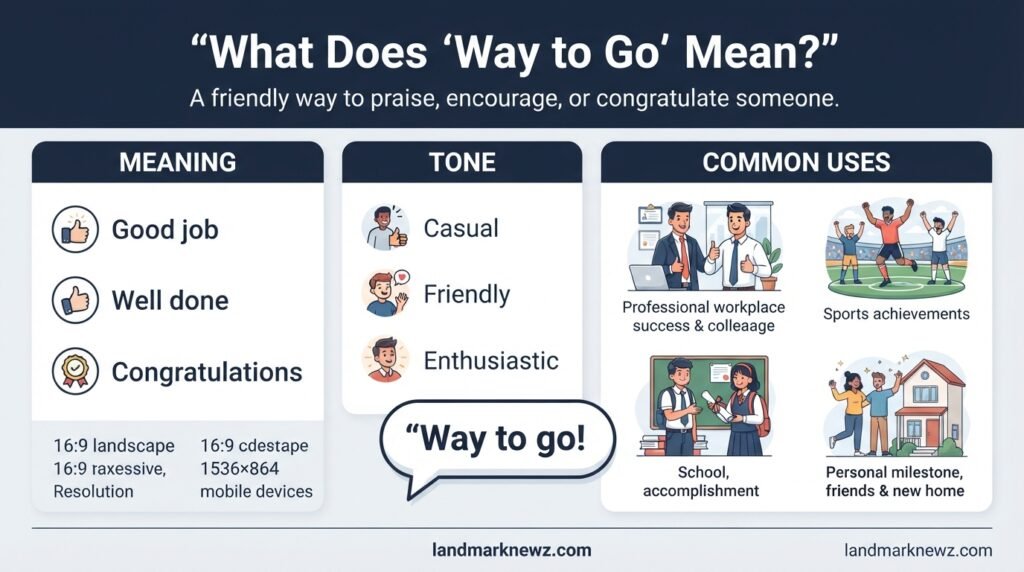
“Way to go” means “good job” or “well done.” People use it to show approval or excitement about something another person has accomplished.
For example, if a coworker finishes an important project ahead of schedule, you might say, “Way to go!” Similarly, you could use it when a friend reaches a goal, wins a competition, or handles a difficult situation successfully.
The expression is generally casual, friendly, and enthusiastic. It is especially common in everyday American conversations, texts, social media posts, sports, classrooms, and informal workplaces.
Why Use Other Ways to Say “Way to Go”?
Although “way to go” is perfectly natural, using different expressions can make your communication more precise and engaging.
You may want another phrase to:
- Avoid repeating the same expression.
- Sound more professional at work.
- Make your praise warmer or more personal.
- Match the seriousness of someone’s achievement.
- Show stronger excitement or enthusiasm.
- Choose language that fits a formal or casual setting.
For example, “Excellent work on the presentation” sounds more professional than “Way to go!” Meanwhile, “You crushed it!” communicates stronger excitement among friends.
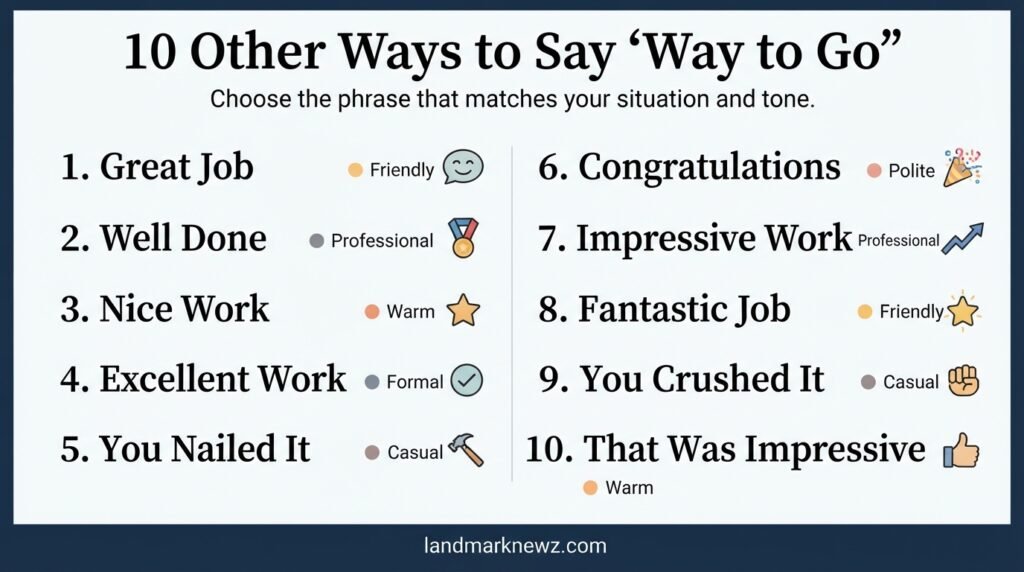
10 Best Other Ways to Say “Way to Go”
1. Great Job
Meaning
“Great job” is one of the simplest and most natural alternatives to “way to go.” It directly tells someone that you are impressed with what they accomplished.
It works well because it is positive without sounding overly formal or dramatic.
Best For
- Professional
- Casual
- Friendly
- Warm
Example 1
Great job on getting the report finished before the deadline.
Example 2
Great job organizing the event; everything ran smoothly.
Quick Tip
Use “great job” when you want a safe, versatile compliment that works in both personal and workplace conversations.
2. Well Done
Meaning
“Well done” is a classic way to praise someone for completing something successfully. It can sound slightly more polished than “way to go,” while still feeling natural.
The phrase is suitable for many situations, from praising a coworker to congratulating a student.
Best For
- Professional
- Formal
- Friendly
- Polite
Example 1
Well done on completing the training program so quickly.
Example 2
Well done! Your presentation was clear, organized, and engaging.
Quick Tip
Choose “well done” when you want your praise to sound polished without becoming overly formal.
3. Nice Work
Meaning
“Nice work” is a friendly and relaxed compliment that recognizes someone’s effort or achievement. It is especially common when giving quick feedback.
It can be used after someone completes a task, solves a problem, or produces something impressive.
Best For
- Professional
- Casual
- Friendly
Example 1
Nice work identifying the issue before it affected the rest of the team.
Example 2
Nice work on the new design; the layout looks much cleaner.
Quick Tip
“Nice work” is a good choice when you want to praise someone without making the compliment sound overly enthusiastic.
4. Excellent Work
Meaning
“Excellent work” communicates stronger praise than “nice work” or “good job.” It emphasizes that the person’s performance reached a particularly high standard.
This phrase fits professional feedback, academic settings, presentations, and formal recognition.
Best For
- Professional
- Formal
- Polite
Example 1
Excellent work on the quarterly analysis. The findings were detailed and well supported.
Example 2
You delivered excellent work despite having a very tight deadline.
Quick Tip
Use “excellent work” when praising quality, accuracy, effort, or performance in a professional setting.
5. You Nailed It
Meaning
“You nailed it” is an enthusiastic, informal expression meaning someone did something extremely well. It suggests that the person achieved exactly what was needed.
The phrase is common in conversations with friends, coworkers you know well, and teammates.
Best For
- Casual
- Friendly
- Warm
Example 1
You nailed it with that presentation—the audience stayed engaged the entire time.
Example 2
That answer was exactly right. You nailed it!
Quick Tip
Because “you nailed it” is informal, avoid it in highly formal correspondence or situations where a more professional tone is expected.
6. Congratulations
Meaning
“Congratulations” focuses on the person’s achievement rather than simply the quality of their performance. It is especially appropriate for major milestones and accomplishments.
You can use it for promotions, graduations, awards, competitions, new jobs, and other meaningful events.
Best For
- Professional
- Formal
- Friendly
- Warm
Example 1
Congratulations on earning the promotion—you worked hard for it.
Example 2
Congratulations on completing your degree. This is a wonderful achievement.
Quick Tip
Use “congratulations” when someone has reached a significant milestone rather than simply completed an everyday task.
7. Impressive Work
Meaning
“Impressive work” tells someone that their results stood out to you. It highlights the quality, skill, creativity, or impact behind an accomplishment.
The phrase sounds professional while still expressing genuine appreciation.
Best For
- Professional
- Formal
- Polite
Example 1
This is impressive work, especially considering the limited time available.
Example 2
Your research was thorough, and the final analysis is truly impressive.
Quick Tip
“Impressive work” is particularly useful when you want to praise someone while emphasizing the quality of their results.
8. Fantastic Job
Meaning
“Fantastic job” expresses strong enthusiasm and positive emotion. It is more energetic than “nice work” and can make praise feel warmer.
It works particularly well in conversations, team settings, classrooms, and informal messages.
Best For
- Casual
- Friendly
- Warm
Example 1
Fantastic job leading the team through such a challenging project.
Example 2
You did a fantastic job decorating the room for the celebration.
Quick Tip
Use “fantastic job” when you want your praise to sound enthusiastic and personal.
9. You Crushed It
Meaning
“You crushed it” is a highly informal expression meaning someone performed extremely well. It communicates confidence, excitement, and strong approval.
It is common in casual American English, especially among friends, teammates, and coworkers with an informal relationship.
Best For
- Casual
- Friendly
- Warm
Example 1
You crushed it during the interview! I knew you would do great.
Example 2
The team crushed it at the tournament this weekend.
Quick Tip
Save “you crushed it” for relaxed conversations because it may sound too casual in formal emails or business communication.
10. That Was Impressive
Meaning
“That was impressive” praises the result of a specific action, performance, or achievement. It sounds natural and sincere without relying on a common compliment such as “good job.”
It is useful when you want to draw attention to something that genuinely stood out.
Best For
- Professional
- Casual
- Friendly
- Polite
Example 1
That was impressive—you explained a complicated topic in a way everyone could understand.
Example 2
That was impressive. You solved the problem much faster than I expected.
Quick Tip
Use this phrase when you want to connect your praise directly to something the person just did.
Comparison Table
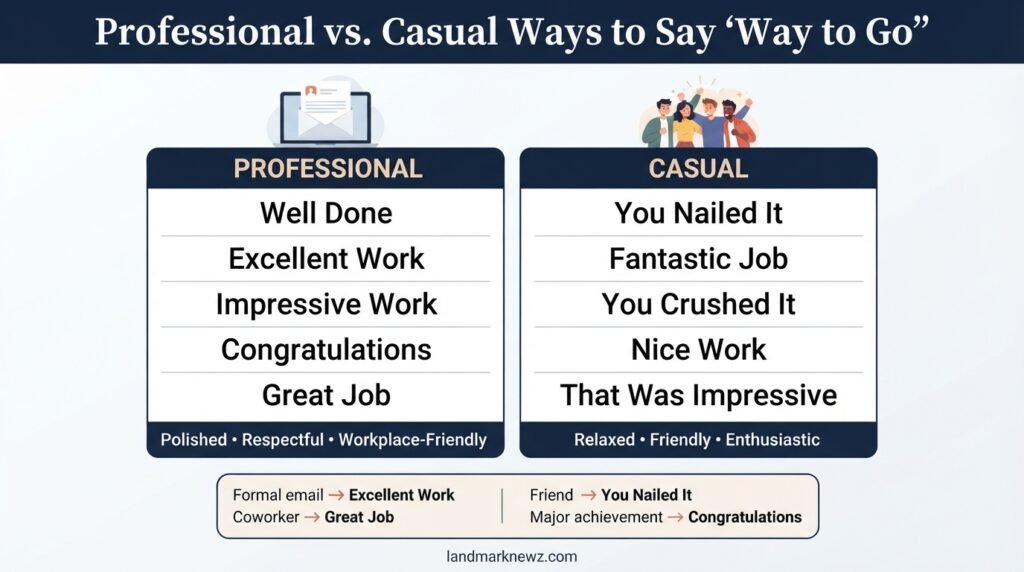
| Alternative | Best Used In | Tone |
| Great job | Work, school, everyday conversations | Positive, versatile |
| Well done | Professional and everyday settings | Polished, approving |
| Nice work | Work, school, casual conversations | Friendly, relaxed |
| Excellent work | Professional and academic settings | Formal, appreciative |
| You nailed it | Informal conversations | Casual, enthusiastic |
| Congratulations | Major achievements and milestones | Warm, celebratory |
| Impressive work | Professional feedback | Professional, appreciative |
| Fantastic job | Informal praise and team settings | Warm, enthusiastic |
| You crushed it | Friends, teams, casual workplaces | Very casual, energetic |
| That was impressive | Specific accomplishments | Sincere, positive |
Common Mistakes
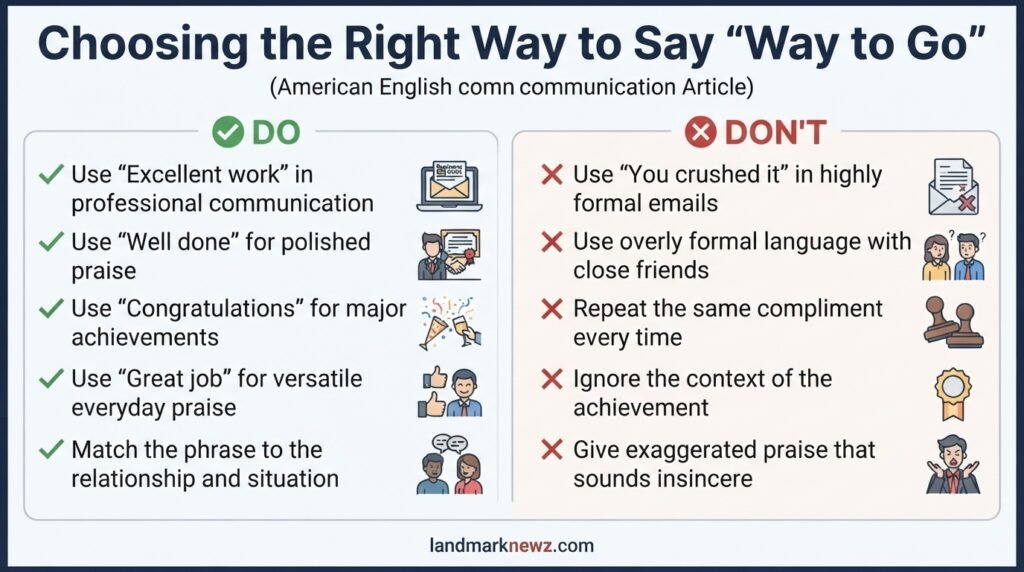
1. Using Casual Phrases in Formal Emails
Expressions such as “you crushed it” and “you nailed it” can sound too informal in a formal business email. Choose “excellent work,” “well done,” or “impressive work” instead.
2. Choosing Overly Formal Language
Not every compliment needs to sound professional. Saying “Your performance was exceptionally commendable” to a close friend can feel stiff and unnatural.
3. Repeating the Same Phrase
Using “great job” after every achievement can make your praise feel routine. Vary your wording based on the accomplishment and relationship.
4. Forgetting the Context
A major promotion deserves a different response from a completed homework assignment. Consider the importance of the achievement before choosing your compliment.
5. Sounding Insincere
Strong words can lose their impact if you use them for every small accomplishment. Make your praise specific when possible so it feels genuine.
Frequently Asked Questions
What is another way to say “way to go”?
Common alternatives include “great job,” “well done,” “nice work,” “excellent work,” “fantastic job,” and “congratulations.” For casual conversations, you can also say “you nailed it” or “you crushed it.” The best option depends on how enthusiastic, professional, or personal you want your compliment to sound.
Is “great job” the same as “way to go”?
Yes, “great job” and “way to go” are very similar because both express approval and praise. However, “way to go” often sounds more energetic and conversational, while “great job” is slightly more neutral and versatile. Both can work in everyday conversations, workplaces, classrooms, and friendly messages.
What is a professional way to say “way to go”?
Professional alternatives include “well done,” “excellent work,” “impressive work,” and “congratulations.” These expressions are appropriate for emails, performance feedback, team messages, and workplace recognition. “Excellent work” is particularly useful when you want to praise the quality of someone’s performance.
What is a casual way to say “way to go”?
For a casual tone, try “you nailed it,” “you crushed it,” “awesome job,” or “fantastic job.” These phrases sound energetic and friendly. They are best suited to conversations with friends, teammates, family members, or coworkers you know well.
How do you say “way to go” in an email?
For a professional email, you can write “Great job on the presentation,” “Well done on completing the project,” or “Excellent work on the report.” If the person achieved an important milestone, “Congratulations on your achievement” is also appropriate.
Is “well done” professional?
Yes. “Well done” is a polished expression that works in many professional settings. You can use it to recognize a successful presentation, completed project, strong performance, or meaningful accomplishment. It is positive without sounding overly casual or excessively enthusiastic.
Can I say “you nailed it” at work?
You can use “you nailed it” in an informal workplace where conversational language is common. However, it may not be suitable for a formal email, executive communication, or a serious business document. In those settings, “excellent work” or “well done” is usually a safer choice.
What is a strong way to compliment someone’s achievement?
“Congratulations,” “excellent work,” and “that was impressive” are strong choices. For a more enthusiastic and casual response, “you crushed it” communicates high energy. If the accomplishment is a major milestone, “congratulations” is often the most natural because it directly recognizes the person’s success.
Conclusion
Finding another way to say “way to go” can help you make your praise sound more natural, specific, and appropriate for the situation. Although “way to go” is friendly and enthusiastic, alternatives such as “great job” and “well done” offer more flexibility.
For professional communication, “excellent work,” “impressive work,” and “well done” are reliable choices. For friends or informal conversations, “you nailed it,” “fantastic job,” and “you crushed it” add more energy. When someone reaches an important milestone, “congratulations” is usually the strongest option. For more guidance on giving compliments at work, consider how your praise fits the situation and relationship.
The key is to match your words to the achievement, relationship, and setting. A thoughtful compliment does more than praise someone—it shows that you noticed their effort and genuinely appreciated the result.

Language & Everyday Communication Specialist
Elena Voss is a language enthusiast and communication coach with over 9 years of experience helping people express themselves more naturally in English. She previously worked as an ESL instructor and corporate language trainer, guiding professionals and students on clearer everyday conversations, polite alternatives, and natural phrasing.
Elena specializes in practical synonym guides and “another way to say…” content that feels conversational rather than textbook. Her writing focuses on real-life situations — emails to friends, casual workplace chat, social media, and daily interactions. She believes the best language advice is simple, useful, and easy to remember.
When she’s not creating content for LandmarkNewz, Elena enjoys analyzing modern slang trends and testing new phrases in real conversations.